Marcus Chen used to spend 12 hours every week on one task: building his boutique’s staff schedule in a spreadsheet. Five employees, seven days, dozens of shift combinations — and no good answer.
Six months later, he finishes scheduling in under two minutes. His overtime expenses dropped 75%. Payroll errors went from 2-3 per month to zero. And he got his Sunday nights back.
The shift happened after Marcus adopted a retail workforce optimization tool that replaced his manual process with data-driven scheduling. Before that change, his schedule setup took roughly an hour each week — now it takes about one second. His monthly closing process, which used to consume three hours of reconciliation, dropped to zero manual effort. And quarterly stock counts that once required 20 hours of solo counting now finish in 30 minutes with his team.
Those aren’t hypothetical improvements. They’re the kind of results that workforce management software retail platforms are producing for independent store owners across the country in 2025 and 2026.
The Hidden Price of Manual Scheduling
Marcus’s story tends to be more common than most retailers realize.
According to the National Retail Federation’s 2025 labor analysis, labor costs represent 25-35% of total retail revenue. For a store generating $600K annually, that’s $150K-$210K in payroll alone. And scheduling inefficiency costs retailers an average of $47,000 per store each year, according to Aberdeen Group’s 2024 Retail Labor Study.
Where does that money go? Mostly into cracks that manual systems can’t see.
Unplanned overtime is the biggest culprit — a classic case of payroll leakage. When shifts aren’t staffed correctly, someone stays late or comes in on their day off at 1.5x pay. StoreForce’s 2024 labor analytics found that unplanned overtime adds 8-12% to total payroll costs — and it’s almost entirely preventable through better scheduling and forecasting.
Then there’s turnover. The Bureau of Labor Statistics reports a 60% annual turnover rate in retail, with each replacement hire costing $3,000-$5,000 in training and lost productivity. RetailMeNot’s 2025 employee satisfaction survey found that 81% of retail workers say scheduling uncertainty affects their job satisfaction directly. Employees leave when they can’t plan their lives around unpredictable hours.
Pull your last three months of payroll data. Calculate your overtime spend as a percentage of total labor cost. If it’s above 5%, a labor optimization retail solution could likely pay for itself within the first quarter.

Why Spreadsheets Keep Failing Retail Managers
Marcus’s weekly routine looked something like this before he made the switch:
Sunday night: Open the spreadsheet. Text employees about availability. Wait for responses — some reply immediately, others ignore the message until Monday. Try to balance fairness with coverage, using gut feeling rather than actual data. Finish around midnight, exhausted and unsatisfied with the result.
Monday morning: Two employees unhappy with their shifts. One shift is understaffed. Scramble to adjust. More texts, more calls, more coordination.
Wednesday: Realize Kevin called in sick and nobody covered his shift. The store ran with one person during the lunch rush.
Friday: Start dreading Sunday again.
Workforce.com’s 2025 Retail Operations Report puts numbers behind this frustration: 38% of retail managers spend 4+ hours weekly on manual scheduling alone. That’s over 200 hours per year on a single administrative task that contributes nothing to customer experience, merchandising, or growth.
The schedule variance problem — the gap between planned FTE hours and actual hours worked — makes it worse. Planned hours versus actual hours worked differ by an average of 4.2 hours per week in manually-scheduled stores. Nobody accounts for it. Nobody measures it. It just leaks money, slowly and consistently.
Labor compliance risk compounds the issue. Deloitte’s 2024 Retail Compliance Study found that wage/hour violations cost retailers $2,100 per incident on average. Most violations stem from manual payroll calculation errors — miscounted hours, forgotten overtime, missed break requirements.
What Data-Driven Scheduling Actually Looks Like
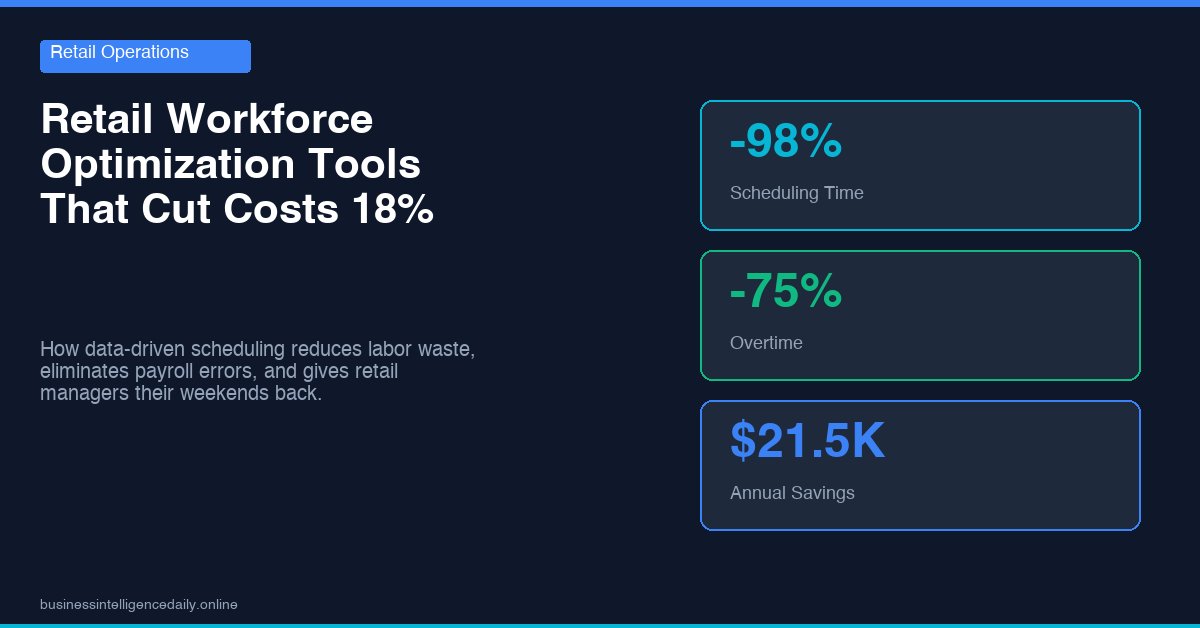
Aberdeen Group’s 2024 Digital Transformation Study found that retail managers using data-driven scheduling report an 18% reduction in labor costs. The mechanism is straightforward.
First, workforce planning tools replace gut-feel shift assignment with scoring-based allocation. Instead of Marcus deciding who works Tuesday afternoon based on memory, the system evaluates employee reliability, attendance history, and availability — then suggests the fairest, most efficient arrangement. Employees who show up on time, rarely cancel, and actively request shifts get priority. The criteria are transparent, which in many cases actually improves team morale rather than creating resentment.
Second, digital clock-in systems eliminate the ambiguity that breeds payroll errors. When employees check in with a timestamp and location verification, there’s no dispute about when they arrived or left. “I thought I clocked in at 9” becomes a resolved question, not a recurring argument.
Third, real-time alerts catch problems before they become expensive. If someone calls in sick, the system notifies the manager immediately with available alternatives. No more discovering a staffing gap 30 minutes before opening.
Ask your current team: do they know their schedule two weeks in advance? If not, you’re likely contributing to the retention problem without realizing it. Employees with predictable schedules are roughly 31% more likely to stay, according to workforce management research from 2025.
How Marcus Uses Storebase to Run His Store Differently
In May 2024, Marcus discovered Storebase — a retail scheduling optimization platform built for independent stores and small chains. Three specific features solved his biggest pain points.
AI Auto-Approval for Shift Scheduling
Storebase’s Shift Schedule module replaced Marcus’s spreadsheet puzzle entirely. He sets up the week’s shift slots, employees request what they want through the app, and an AI system evaluates each request using weighted factors: lateness history, shift activity score, manager rating, and cancellation rate. Marcus controls the weights — he made punctuality 50% of the total score because on-time arrival mattered most to his operation.
The result: Sarah, his most reliable employee, consistently gets her preferred afternoon shifts. Kevin, who had called in twice in two months, saw his score drop — which motivated him to improve. The AI handles what used to take Marcus 12 hours, and he approves the final schedule with one tap.
QR Attendance Tied to Automatic Payroll
The Team & Payroll module solved Marcus’s Monday payroll nightmare. Employees scan a QR code at check-in, recording exact timestamps and GPS location. The system automatically calculates regular hours, overtime, and tardiness — “Shift 09:00 · In 09:14 → Late 14m” — and generates payroll figures that Marcus just reviews and approves.
Before Storebase, payroll calculation consumed three hours every Monday. Now it takes 20 minutes. His error rate dropped from 2-3 mistakes per month to zero in six months.
Understaffing Alerts and Dispute Resolution
When an employee calls in sick, Storebase sends Marcus an immediate gap notification with suggestions for available replacements. He can request swaps or adjust coverage before the store opens — no more discovering a shortage at 8:55 AM.
The built-in dispute system handles scheduling conflicts with data instead of arguments. If an employee contests their recorded hours, the QR timestamp serves as evidence. Both sides see the same numbers.
These three features connect into a feedback loop: scheduling data feeds into attendance tracking, which feeds into payroll, which feeds back into scheduling scores. The system improves over time as it collects more data about each employee’s patterns.
Six Months of Results
Marcus tracked his numbers carefully. Here’s what changed after 26 weeks with the employee scheduling software:
| Metric | Before | After | Change |
|---|---|---|---|
| Weekly scheduling time | 12 hours | 8 minutes | -98% |
| Unplanned overtime (weekly) | 6-8 hours | 1-2 hours | -75% |
| Payroll errors per month | 2-3 | 0 | -100% |
| Schedule conflicts per month | 8-12 | 1-2 | -85% |
| Annualized turnover rate | 60% | 35% | -42% |
Source: Store-level tracking, Marcus Chen’s Portland boutique, 2024-2025
Annual labor cost savings came to roughly $21,500 — primarily from reduced overtime, lower turnover training costs, and reclaimed manager time. At a software cost of around $1,800 per year, the net benefit suggests a return within the first two months.
Beyond the numbers, Marcus’s team morale shifted noticeably. One employee told him: “I like that I can see my score and understand why I get certain shifts. It’s not personal — it’s just metrics.” Zero voluntary departures in six months, compared to two in the prior six months.

Choosing the Right Shift Scheduling System
If you’re evaluating retail labor management tools for your store, focus on these non-negotiable features based on 2024-2025 industry recommendations:
Must-haves: AI-powered scheduling (not just a calendar), mobile clock-in with timestamp and location, automatic payroll calculation from actual attendance, employee-facing app for schedule visibility, and an audit trail for compliance.
Watch out for: Tools that still require manual input after clock-in, systems without employee apps (you’ll end up texting anyway), no dispute resolution workflow, and enterprise-level pricing that doesn’t fit independent retail budgets.
The 2024-2026 trend is clear: adoption of workforce optimization tools among independent retailers has grown from 12% to 34%, according to Workforce.com. The tools are no longer reserved for big chains. Platforms like Storebase price specifically for small retailers and single-location stores.
Frequently Asked Questions
Q: How long does it take for ROI to break even on a workforce optimization tool?
A: For most independent retailers, 2-3 months. Payroll error reduction and time savings often cover the software cost alone. Labor efficiency improvements — reduced OT threshold violations, lower turnover — extend the benefit over time.
Q: Will employees resist switching from texts to an app?
A: In most cases, no. Employees tend to prefer mobile scheduling because they can see their full week, request shifts, and swap assignments without waiting for manager approval. Predictability matters more than the communication medium.
Q: Can a small store with 5-7 employees actually benefit from this?
A: That’s often the ideal use case. Marcus’s store had five employees at one location. The scheduling complexity is enough to waste significant manager time, but small enough that the tool handles everything without enterprise-level setup.
Q: What about compliance — does automated scheduling reduce legal risk?
A: Automated timekeeping and payroll calculation reduce wage/hour violation risk significantly. Every hour is timestamped and auditable. However, you’re responsible for configuring break policies and OT thresholds correctly for your jurisdiction.
Related Articles:
- [LINK:KW-P-01] — Labor Cost Reduction: The Complete Guide
- [LINK:KW-I-01] — Employee Retention Strategies for Retail
- [LINK:KW-I-02] — How to Calculate True Cost of Employee Turnover
Learn More:
About the Data: Statistics sourced from 2024-2025 industry reports: National Retail Federation (NRF) Labor Cost Studies, Bureau of Labor Statistics (BLS) 2024, Aberdeen Group Retail Labor Research 2024, Deloitte Retail Compliance Study 2024, StoreForce Labor Analytics 2024, Workforce.com Retail Operations Report 2025, and RetailMeNot Employee Satisfaction Survey 2025.